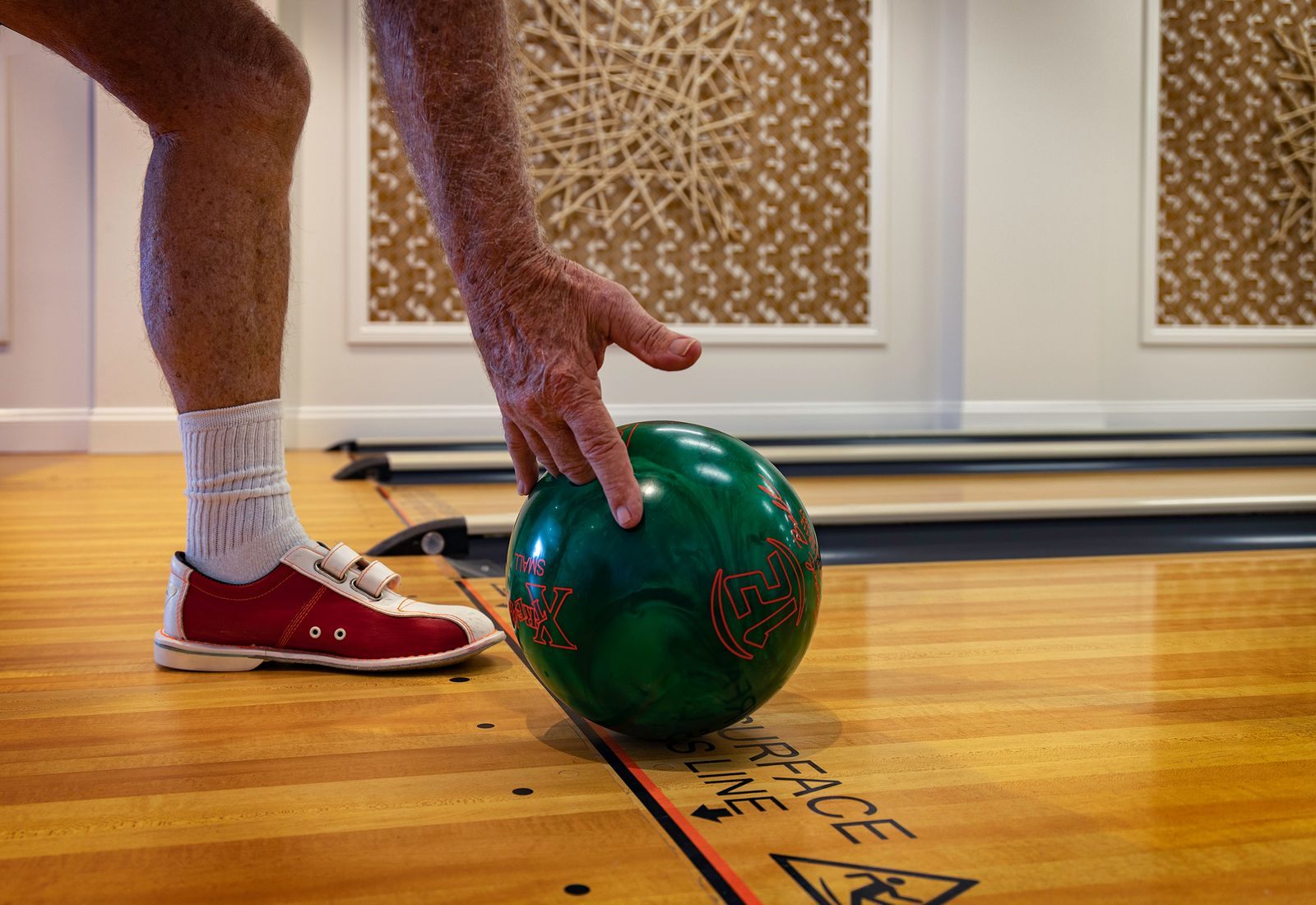
Learning how to bowl well is mostly about repeating one simple motion. Here is that motion broken into parts: the grip, stance, four-step approach, swing, release and follow-through, plus how to aim.
Grip
With a typical house ball, put your middle and ring fingers in the two finger holes up to the second knuckle and your thumb all the way into the thumb hole. Your hand should feel snug but not squeezed; you should be able to hold the ball with a relaxed grip. If you have to clench, the ball is too heavy or the holes don’t fit — try another. See ball weight and fit.
Stance
- Find your starting spot: stand with your back to the pins at the foul line, take four and a half normal steps toward the back, turn around. Note which dots you are standing on.
- Feet together or the sliding foot slightly ahead, knees soft.
- Hold the ball at waist height, slightly toward your bowling side, with your other hand supporting its weight.
- Shoulders square to your target, eyes on your arrow.
The Four-Step Approach
| Step | Feet | Ball |
|---|---|---|
| 1 | Short step with your bowling-side foot | Push the ball forward and slightly down |
| 2 | Normal step | Ball swings down past your leg |
| 3 | Slightly longer step | Ball reaches the top of the backswing |
| 4 | Slide toward the foul line | Ball swings through and is released |
The timing that matters is that the ball and your feet arrive at the line together. If you are rushing ahead of the ball, shorten your steps or start the push-away earlier.

Swing and Release
Let your arm hang and swing like a pendulum from the shoulder. Don’t muscle it: the backswing should rise no higher than your shoulder. As you slide into your last step, bend your knee so the ball is released low, just past the front of your sliding foot. Your thumb comes out first, then your fingers lift through the ball. Keep your wrist firm and your hand behind the ball, like shaking hands with someone at the end of the lane.
Follow-Through
After the release, keep reaching toward your target with your arm finishing up near your head. Hold your balanced finish position until the ball crosses the arrows. A good follow-through keeps the ball on line; a short, chopped one usually sends it off target.
How to Aim: Spot Bowling
The lane has a set of seven arrows about 15 feet past the foul line, and the pins are 60 feet from the line. Experienced bowlers look at the arrows, not the pins. A right-handed beginner often starts by rolling over the second arrow from the right; a left-hander over the second from the left. Watch where the ball hits the pins, then adjust your feet a board or two and keep the same target.
How to Bowl: Questions
Which foot do I start with?
In a four-step approach, right-handed bowlers start with the right foot and slide on the left; left-handers do the opposite. In a five-step approach, you start with the other foot.
Should I throw straight or hook the ball?
Beginners should roll the ball straight with a relaxed, handshake-style release until their approach is consistent. A hook adds entry angle at the pins and comes with practice, ideally with a coach.
What happens if I step over the foul line?
Under USBC rules, a ball delivered while you touch or cross the foul line is a foul and counts as zero pins for that delivery. In casual open play the sensor may not be switched on, but it is still a good habit to stop behind the line.
Common Mistakes and Fixes
| Problem | Likely cause | Try this |
|---|---|---|
| Ball bounces on the lane | Releasing too high | Bend your sliding knee more and release just past your front foot. |
| Ball drifts left or right off target | Shoulders turning or looking up early | Keep shoulders square; watch the arrow until the ball passes it. |
| Fouling over the line | Starting too close or overstriding | Move your start spot back half a step. |
| Arm sore after one game | Ball too heavy or gripping too hard | Drop a pound or two and relax the grip. |
| Ball hits the gutter early | Wrist turning at release | Keep a firm wrist with the hand behind the ball. |
Next: How Bowling Is Scored
See how strikes, spares and the tenth frame work, then score a game yourself with our free calculator.
Learn the Scoring System